


July 27, 2026
Why Your FUE Donor Area Shows Up in a Mid Fade - and What Actually Fixes It
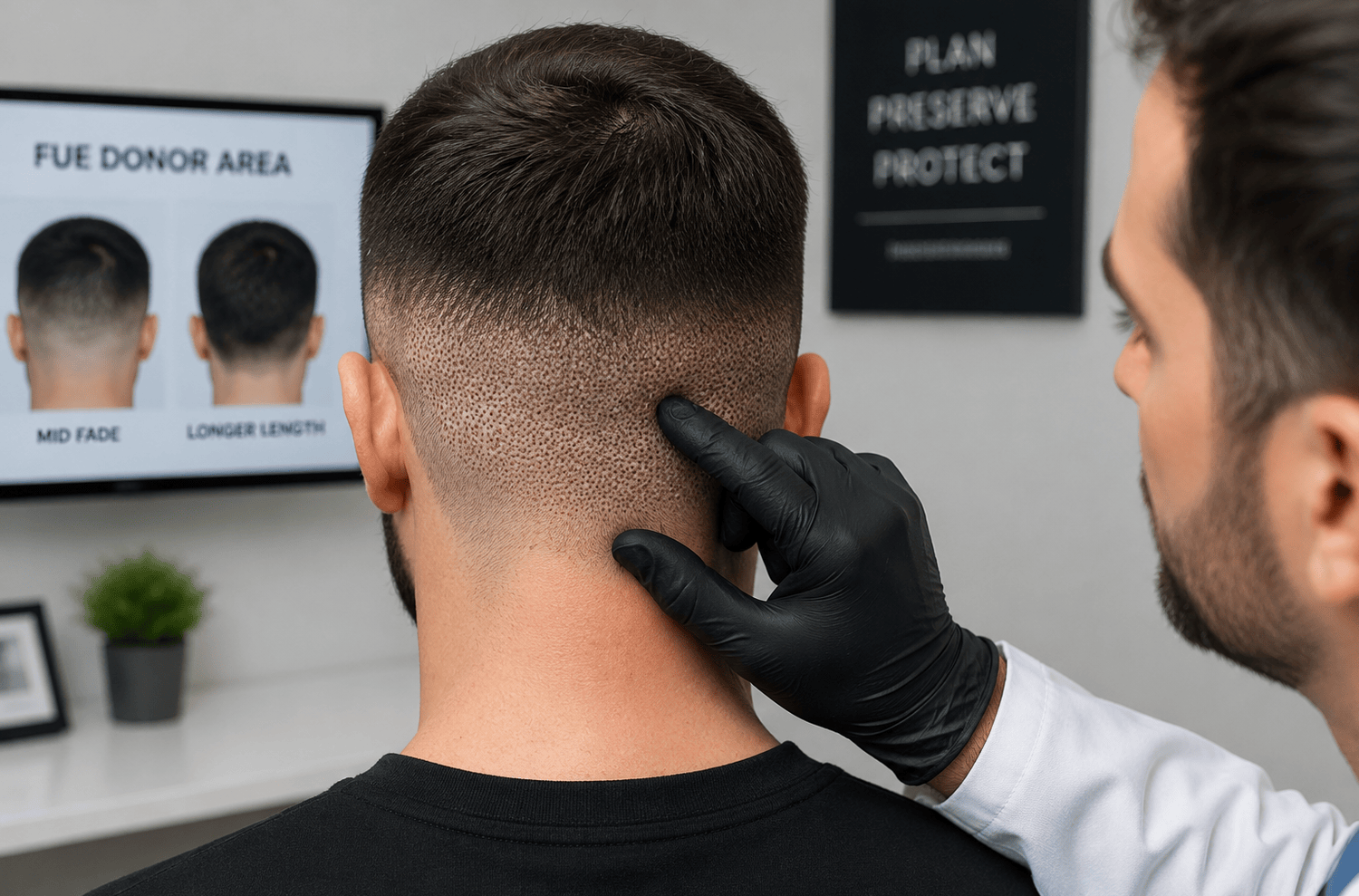
If you had an FUE hair transplant, went in for a shorter haircut than usual, and suddenly noticed a field of tiny pale dots across the back and sides of your head, you are not imagining it and you are not alone. This is one of the most common surprises in hair restoration, and it tends to arrive months or years after surgery, on the day a barber takes the clippers up higher than they ever have before.
This is a well-understood phenomenon with a well-understood fix. The problem is that the internet gives wildly contradictory explanations for it, most of which collapse a multi-variable problem into a single villain. Here is what is actually going on.
What the white dots actually are
Every FUE extraction is a small circular punch through the skin down to the follicle. That punch removes a full-thickness plug of tissue, and the body heals it the way it heals any full-thickness wound: with scar tissue. Scar tissue does not contain melanocytes, the cells that produce pigment. That is why the dots appear lighter than the surrounding scalp rather than darker, and why they become more obvious when you tan rather than less the skin around them darkens while the dots stay the same. Dermatologic literature calls this hypopigmented punctate scarring, and it is described in detail in the International Society of Hair Restoration Surgery's clinical case literature.
Crucially, this is a contrast problem rather than a scar problem. Two thousand dots are invisible under 12mm of hair; they appear only when the covering hair gets short enough that pale skin shows between the shafts. That is why the same donor area can look flawless at a number 2 guard and obvious at a skin fade.
Why some people show dots and others do not
Online you will see this attributed almost entirely to punch size, usually by someone arguing that a good surgeon uses a tiny punch and a bad one does not. Punch diameter is real, and it matters, but it is one of at least four variables.
1. Punch diameter
Larger punches remove more tissue and leave larger scars, and published measurements show that a scar continues to remodel to a final diameter somewhat wider than the punch that made it. A structured clinical framework for donor site preservation in FUE places the most commonly used punch sizes in roughly the 0.8–0.9mm range. But smaller is not automatically better: an undersized punch increases transection (cutting through the follicle) and forces repeated attempts on the same site, which can produce more local trauma, not less. It takes a combination of small punches (such as the .7mm ones used at HRIMN) and the skill to use them without transection.
2. Extraction density
This is the variable most patients never think about and the one that arguably matters most. Taking 2,000 grafts spread evenly across a wide donor zone leaves a very different donor area than taking 2,000 grafts concentrated into a narrow strip. Over-harvesting a small area produces clustered scarring and visible thinning that no punch size can rescue. Donor management over a patient's lifetime preserving capacity for a second or third procedure is one of the clearest markers separating a surgeon planning for the long term from a clinic optimizing for today's graft count.
3. Your individual healing biology
Two patients can receive identical work from the same surgeon on the same day and heal differently. Skin thickness, laxity, phototype, and individual scarring tendency all influence how prominent the final dots are. Nobody controls this variable, which is why blanket claims that visible dots always mean a bad surgeon are unfair experienced practitioners will tell you plainly that some patients simply scar more.
4. Skin tone and contrast
The greater the difference between your scalp pigment and the scar tissue, the more visible the dots are, which also means sun exposure generally makes them worse, contrary to advice suggesting you tan to blend them in.
What actually fixes it
Change the haircut first it is free
Before considering any procedure, take a photograph of the problem to your barber. Most patients who notice dots at a mid or high fade find that dropping to a low fade or a taper, or simply moving from a skin fade to a number 1 or 1.5 guard, eliminates the issue entirely. A quarter-inch of length change is often the whole difference. This costs nothing and is reversible.
Scalp micropigmentation
Scalp micropigmentation is the standard clinical answer when a haircut change is not enough. SMP deposits pigment into the scalp in patterns that mimic the appearance of follicles, restoring the contrast the scar tissue destroyed. Because FUE dots are small, flat, and evenly distributed, they are among the most cooperative scars to camouflage each dot can be individually targeted. Combining SMP with hair transplantation is a recognized technique in the hair restoration surgical literature, and camouflaging FUE extraction sites is one of its explicit indications.
Two caveats before you book. Some SMP pigment fades over years, so ask your provider or plan on periodic maintenance rather than treating it as permanent. And results depend heavily on the practitioner's ability to match dot size, density, and undertone to your existing hair an artistic skill as much as a technical one. Ask any provider to show you healed work, not day-of photos.
What does not work
Tanning to blend the dots backfires, because scar tissue lacks the melanocytes needed to darken. Concealers and hair fibers sit on the hair rather than the scalp and do very little for donor dots. And a second transplant does not remove the first one's scars it adds more extraction sites.
If you have not had surgery yet
If you are still in the planning stage and you wear your hair short, say so at the consultation and say it clearly. It changes the surgical plan: a surgeon who knows you intend to keep a fade can adjust punch selection, spread extractions across a wider donor zone, and set a more conservative graft ceiling. Ask what punch diameter will be used, how many grafts per square centimeter will be harvested, and how much donor capacity remains afterward. Ask to see healed donor photos at short length, not recipient-area before-and-afters, which are what most clinics lead with and which tell you nothing about donor management.
It is also worth knowing that FUT (strip harvesting) trades the field of dots for a single linear scar. Neither is universally better. A well-executed FUT scar hides easily under moderate length but is impossible to hide at a skin fade; a well-executed FUE donor area hides better at short length but is harder to conceal if extraction was aggressive. The right choice depends on how you intend to wear your hair for the next twenty years, not just next month.
The realistic summary
Visible donor dots at short lengths are a normal consequence of FUE that becomes a problem only under specific conditions: high extraction density, larger punches, high skin-to-scar contrast, or a haircut shorter than the donor area was planned for. Most cases resolve with a change in clipper guard. The rest respond well to scalp micropigmentation. And almost none are as visible to other people as they are to the person in the mirror.
Thinking about a transplant, or dealing with donor-area visibility from one you already had? The team at Hair Restoration Institute of Minnesota offers a free, no-pressure consultation where we look at your donor area under magnification, talk honestly about how you wear your hair, and tell you whether a transplant, SMP, or neither is the right next step for you. Learn more at www.HRIMN.com.
