

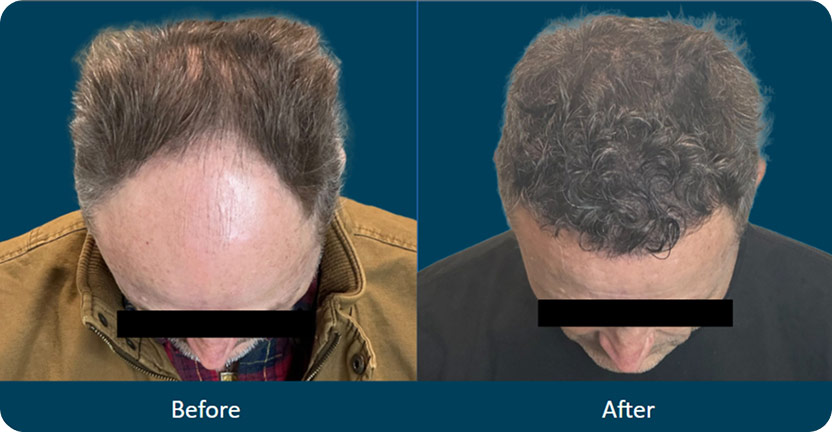
Actual HRIMN patient — frontal hairline and mid-scalp restoration.
Choose Men or Women, tap the scalp zones, and see your estimated graft count, range, and cost. This is the HRIMN graft calculator.
The Short Answer
Most people need 1,800–3,000 grafts.
A Norwood 3 hairline rebuild usually starts around 1,800 grafts; the frontal third runs 1,800–2,500; the crown 1,500–2,500; and a full front-to-crown restoration 3,500–6,000+. Your exact number depends on how much area you want covered and how dense your donor hair is — which is why the calculator gives a range, not a single figure.
The rest of this page shows you exactly how those numbers are built up — by scalp area, by Norwood stage, and by the handful of personal factors that move your total up or down. It’s the same math our surgeons use when they plan a case.
How Many Grafts for Each Area of The Scalp
Surgeons don’t think about your head as one number — they think in zones. Each area is a certain size in square centimeters, and it takes a certain number of grafts to make that area look full. Here are the ranges we typically plan for, assuming a natural, dense-looking result.
| Area of the Scalp | What it Covers | Typical Grafts |
|---|---|---|
| Hairline & temples | Rebuilding a receding front edge and temple points | 1,500–2,500 |
| Frontal third | Hairline plus the central “frontal tuft” that frames the face | 1,800–2,500 |
| Front half | Front third plus the mid-scalp behind it | 2,500–3,200 |
| Front two-thirds | Everything forward of the crown swirl | 3,000–4,000 |
| Crown/vertex | The spiral bald spot at the back-top of the head | 1,500–2,500 |
| Full restoration | Front, mid-scalp and crown together | 3,500–6,000+ |

Why the Crown Eats Grafts.
The crown is a swirl, so hair has to be angled in every direction to look natural, and it sits on a curved surface that shows scalp easily. Many surgeons treat the front first and only add the crown once they’re sure your donor supply can cover both.
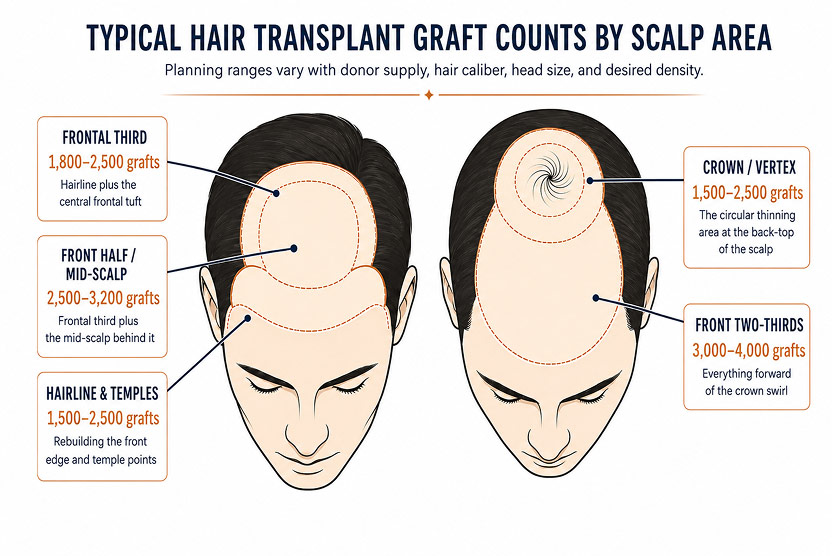
Typical planning ranges by scalp area. Estimates only.
How Many Grafts by Norwood Stage
The Norwood Scale is the standard 7-stage map of male pattern baldness. Finding your stage is the fastest way to sanity-check your calculator estimate. Match your pattern to the closest picture, then read across for a typical graft range.
| Norwood Stage | Pattern | Typical Grafts |
|---|---|---|
| Norwood 2 | Slight mature hairline recession at the temples | 500–1,200 |
| Norwood 3 | Deeper temple recession — the classic “M” shape | 1,800–2,200 |
| Norwood 3 Vertex | Recession plus early thinning at the crown | 2,000–2,600 |
| Norwood 4 | Larger front/temporal loss and a defined crown spot | 2,200–3,000 |
| Norwood 5 | Bridge of hair between front and crown narrowing | 2,800–3,800 |
| Norwood 6 | Front and crown merge; bridge is mostly gone | 3,500–4,800 |
| Norwood 7 | Only a horseshoe of hair on the back and sides | 4,500–6,500+ |
Approximate graft counts by Norwood stage. Donor supply sets the ceiling on higher stages.

Higher Stages are “Donor Dependent.”
By Norwood 6–7 you may want more grafts than your donor area can safely give. The realistic goal shifts to a strong, natural front and mid-scalp with a lighter crown — a plan that looks great and lasts, rather than chasing teenage density everywhere.
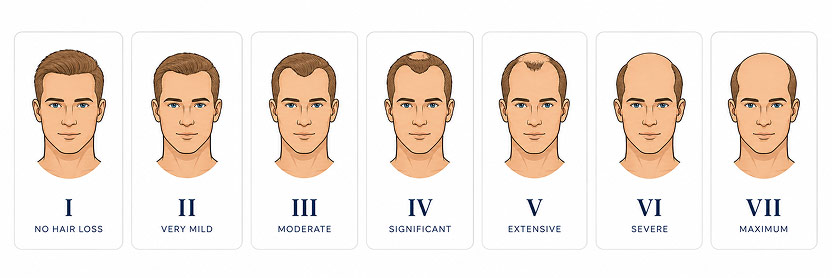
The Norwood Scale — the standard 7-stage map of male pattern hair loss.
Wait — is a Graft the Same as a Hair?
No, and this is the single most misunderstood part of the whole conversation. A graft (also called a follicular unit) is a natural little bundle that grows 1 to 4 hairs — about 2.2 hairs on average. So the numbers work out like this:
2,000 grafts ≈ 4,000–5,000 actual hairs.
When a clinic quotes “hairs” instead of “grafts,” the number sounds bigger for the same amount of work. Always compare clinics on grafts, and ask what a quote actually includes.
This also explains why two people with the same Norwood stage can need different graft counts: someone whose follicles average 3 hairs each gets more coverage per graft than someone averaging 1.8.
The Factors That Change Your number
A calculator estimates the area you want covered. The other half of the equation is you — your donor supply and hair quality. These are the variables our surgeons measure at your consultation:

How we measure it precisely.
At HRIMN we use a HairMetrix scalp scan to read your donor density and hair caliber under magnification. That turns the calculator’s ballpark into a real surgical plan. Your scan is included free when you start any treatment — hair transplant, PRP, exosomes, Growth Factors, or even medication support.
Grafts vs. Density: What “Full” Actually Means
Native hair grows at roughly 80–100 follicular units per cm². You don’t need to match that to look full — because of the shading tricks above, the eye reads a scalp as “full” at around 30–45 FU/cm², roughly half of virgin density. That’s why a well-planned transplant can look complete without replacing every single hair you’ve lost.
This is also the density choice built into the calculator: a dense setting targets the higher end for a fuller front, while a lighter setting spreads your donor supply over more area — useful when coverage matters more than maximum thickness.
Can it Be Done in One Session?
Graft count also decides how many sessions you need, and that depends on the technique.
| Technique | Per-Session Yield | Best For |
|---|---|---|
| FUE (no linear scar) | up to ~2,500–3,000 | Shorter hairstyles, patients who want no linear scar, smaller-to-mid cases |
| FUT/Strip | 3,000+ | Large cases needing maximum grafts in one day; costs slightly less |
| FUE/FUT Hybrid | 4,000+ | Best of both worlds — maximum harvest with minimal depletion of the donor area |
Big restorations (Norwood 5–7) are often handled with our Combination procedure or staged into two sessions. Splitting the work protects your donor area and gives each graft the best possible blood supply and survival. Compare FUE and FUT
What That Many Grafts Costs
Because price tracks graft count, once you know your number you know your ballpark. At HRIMN, FUE runs from $9,499 for up to 1,000 grafts to $14,749 for up to 2,500 grafts, with additional grafts at $3 each. FUT/strip is slightly less. The calculator above turns your estimate into a live price with monthly financing.

Financing
Most patients spread the cost with 0% options at 12 and 24 months, or lower payments over 60 months — a typical FUE works out to roughly $159–$247/month. Get pre-approved with a soft (no-hard-pull) check at pay.withcherry.com/hrimn.
How Many Grafts Do Women Need?
Women lose hair differently than men, so the graft math is different too. Instead of a receding hairline and a bald crown, most women see diffuse thinning — a widening part and see-through density across the top of the scalp, usually with the front hairline still intact. The job is often about adding density to a thinning area rather than covering bare scalp.
Typical graft ranges for women. Estimates only — candidacy depends on donor stability.
| Goal | What it Addresses | Typical grafts |
|---|---|---|
| Hairline lowering | Bringing down a naturally high forehead or reshaping the hairline | 1,500–2,500 |
| Frontal third | Filling a widening part and thinning crown/mid-scalp | 1,500–3,000 |
| Temples / traction alopecia | Edges thinned by years of tight ponytails, braids or extensions | 500–1,500 |
One important difference: female pattern thinning is often diffuse, which means the donor area at the back and sides can be thinning too. If that permanent zone isn’t stable, transplanting from it won’t hold — so a careful evaluation matters even more for women than for men.

Good News for Women.
Because we offer no-shave and low-shave FUE, most women can have a transplant without cutting their existing long hair. And non-surgical options — PRP, Growth Factors, exosomes and SMP — are often an excellent fit for diffuse female thinning, either alongside a transplant or on their own.
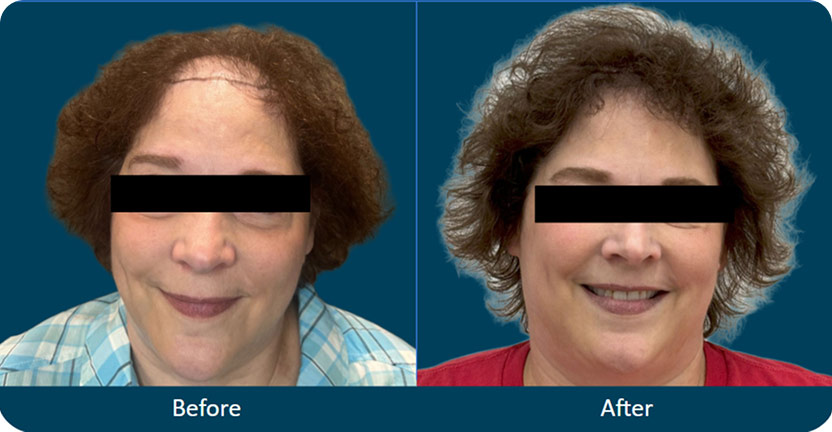
Actual HRIMN female patient — restored hairline and a fuller part.
Why a Real Evaluation Beats Any Calculator
Every online tool on the internet — including ours — is estimating the area you want treated. None of them can see your scalp. Two things can only be measured in person:
1. Your true donor supply.
The number of grafts you can safely harvest without thinning the back and sides is the real ceiling on your result.
2. Your hair quality.
Caliber, curl and contrast can swing the graft count you need by 20–30% in either direction.
That’s why the honest answer to “how many grafts do I need?” is: use the calculator to get oriented, then confirm it with us at a free consultation. Start any treatment package and your HairMetrix scan is included at no charge — so you’ll know your real number backed by real measurements.
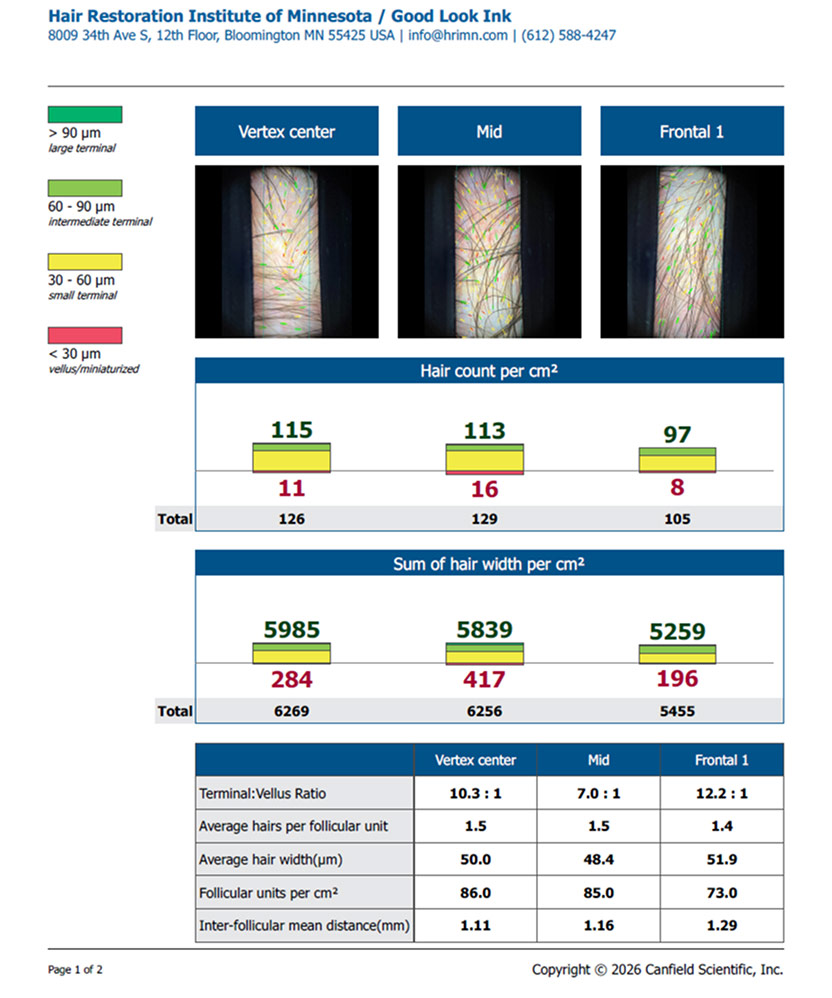
A real HairMetrix scan — measured hair counts, caliber and follicular density by scalp region.
Frequently asked questions
A hairline and temple rebuild for a Norwood 3 pattern typically takes at least 1,800 grafts, and often 1,800–2,500, depending on how far the recession has gone and how low you want the new hairline. The calculator lets you tap just the front zones to see your figure.
Most crowns take 1,500–2,500 grafts. The crown is a swirl on a curved surface, so it needs careful angling and can use more grafts than its size suggests. Surgeons often treat it after the front is secured.
A full front-to-crown restoration usually runs 3,500–6,000+ grafts, often across two sessions or a single Combination procedure. At higher Norwood stages your donor supply, not your wish list, sets the realistic maximum.
Roughly 4,000–5,000 hairs, since each graft grows about 2.2 hairs on average. For a sense of scale, 2,000 grafts is about the number you can fit inside a single handprint. Always compare clinics by grafts, not hairs.
Yes. Women are usually treating diffuse thinning and a widening part rather than a bald area, so cases commonly run 1,500–3,000 grafts. Because we offer no-shave and low-shave FUE, most women keep their long hair. A careful evaluation matters, since female thinning can affect the donor area too.
FUE commonly places up to about 2,500–3,000 grafts per session and FUT/strip 3,000+, while our Combination FUE/FUT procedure can place 4,000+ in a single sitting. Very large cases may still be split to protect the donor area.
It’s a solid estimate of the area you want covered, but it can’t measure your donor density or hair quality. Those require an in-person or HairMetrix scalp evaluation. Book a free consultation and we’ll confirm your real number — no obligation
Get Your Real Number — Free
Run the calculator for a ballpark, then book a complimentary consultation to confirm exactly how many grafts you need and what it will cost. Your HairMetrix scalp scan is included free when you start any treatment package. No pressure, no obligation.
Prefer to talk? Call (612) 588-HAIR — out-of-town? Ask about our Hair by Air travel program.

Medically Reviewed by the HRIMN Clinical Team
The Hair Restoration Institute of Minnesota is a dedicated hair-only restoration clinic in Bloomington, MN, performing FUE and FUT hair transplants and non-surgical hair loss treatment. Graft ranges on this page are typical planning estimates and are not a substitute for an in-person evaluation.
This page and its calculator provide rough estimates for educational purposes only. Your exact graft count, candidacy and price require an in-person evaluation of your hair loss pattern and donor area. Individual results vary. Financing is provided by third-party lenders and is subject to credit approval. Hair Restoration Institute of Minnesota · 8009 34th Ave S, 12th Floor, Bloomington, MN 55425 · (612) 588-HAIR · www.HRIMN.com