

HairMetrix Scalp Scan in Minnesota
AI-Powered Hair and Scalp Analysis at Hair Restoration Institute of Minnesota
If you are noticing thinning hair, a widening part, recession at the temples, reduced density at the crown, or increased shedding, the first step is understanding what is actually happening on your scalp.
At Hair Restoration Institute of Minnesota in Bloomington, we offer HairMetrix scalp scanning, an advanced AI-powered imaging service designed to measure, document, and monitor hair loss with far more precision than a visual inspection alone.
What Is HairMetrix?
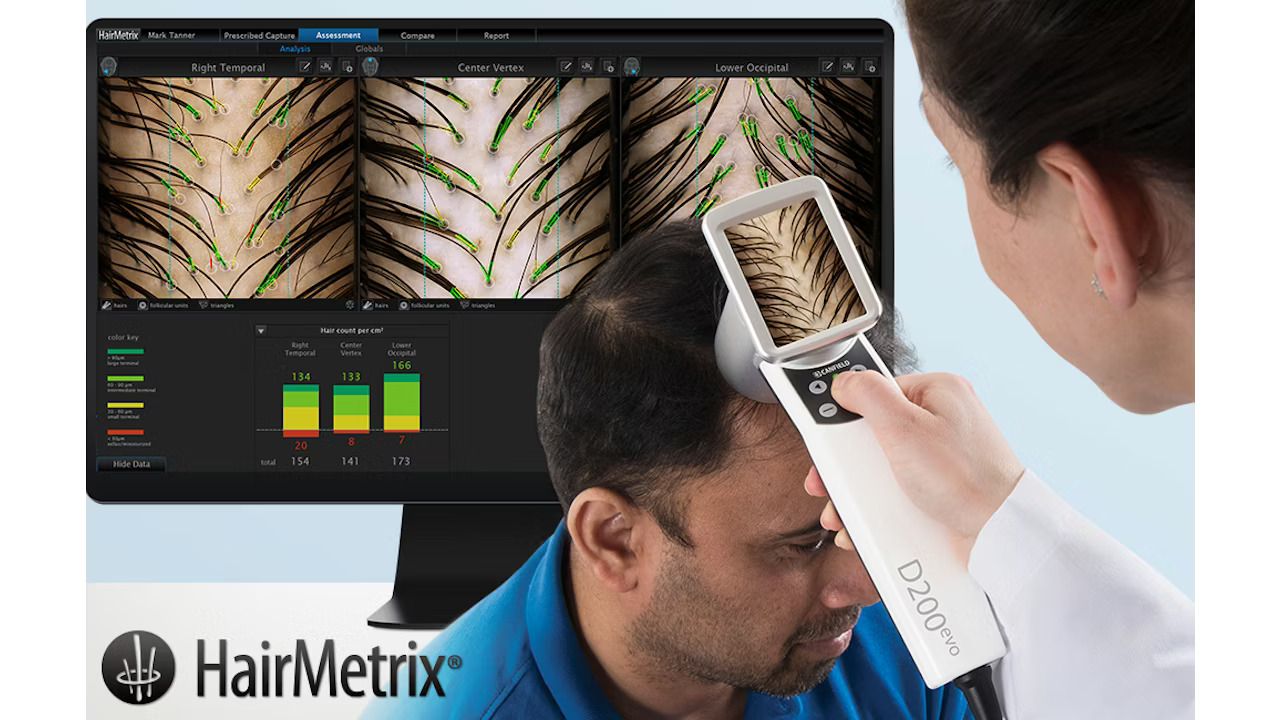
HairMetrix is an AI-powered scalp imaging and analysis system used to evaluate hair and scalp characteristics during a hair loss consultation and to evaluate the effectiveness of treatments.
Instead of relying only on the naked eye, HairMetrix uses high-resolution scalp imaging and automated analysis to measure important hair metrics. These measurements can help identify thinning patterns, establish a baseline, and monitor progress over time.
For patients, the value is simple: HairMetrix helps turn “I think my hair is thinning” or “I wonder if these treatments are working” into measurable information.
This is especially useful because hair loss often happens gradually. Many people do not notice a change until they have already lost a significant amount of visible density. A scalp scan can help detect and document changes earlier, making it easier to choose the right next step.
Why Get a HairMetrix Scalp Scan?
Hair loss can be frustrating because it is not always obvious what is causing it or how quickly it is progressing. Some patients experience genetic hair loss. Others notice shedding after stress, illness, hormonal changes, medication changes, pregnancy, weight loss, or nutritional deficiencies. Many people have more than one factor contributing to thinning.
A HairMetrix scalp scan can help by giving you a clearer, more objective view of your hair and scalp.
A HairMetrix scan may help evaluate:
- Hair density in thinning areas
- Follicular unit density
- Hair shaft thickness
- Miniaturization patterns
- Crown thinning
- Frontal hairline recession
- Diffuse thinning
- Treatment progress over time
- Whether non-surgical treatment may be appropriate
- Whether surgical hair restoration should be considered
HairMetrix is not a standalone diagnosis and does not replace medical evaluation when a medical condition is suspected. Instead, it is a powerful consultation tool that helps HRI create a more informed, personalized plan.
What Does HairMetrix Measure?
During your consultation, HairMetrix may be used to evaluate several important scalp and hair measurements, including:
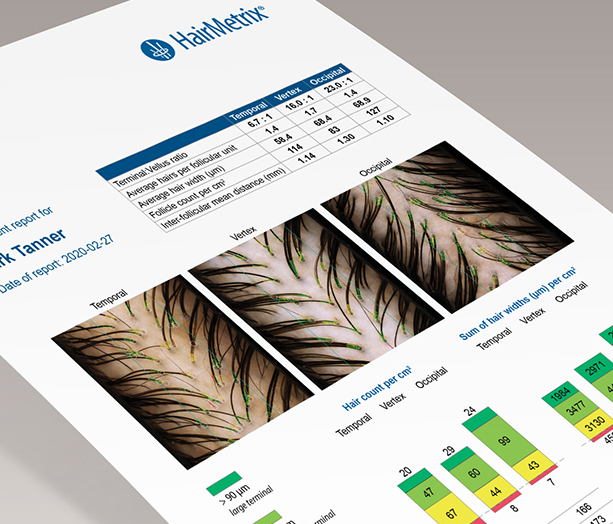
Hair Count
Hair count helps estimate how many hairs are present in a measured area of the scalp. This can be useful for comparing thinning zones against areas with stronger density.
Hair Density
Hair density refers to how much hair is present in a specific area. Patients often describe this as “coverage” or “fullness.” Density is one of the most important factors in how thick or thin the hair appears.
Follicular Units
A follicular unit is a natural grouping of hairs emerging from the scalp. Some follicular units contain one hair, while others contain two, three, or more. Understanding follicular unit patterns can help inform both non-surgical planning and hair transplant planning.
Hair Shaft Thickness
Hair shaft thickness affects the appearance of fullness. Two people may have a similar number of hairs, but the person with thicker hair shafts may appear to have significantly more coverage.
Terminal and Vellus Hair Patterns
Terminal hairs are thicker, mature hairs. Vellus-like hairs are finer, smaller hairs. In many forms of pattern hair loss, thick terminal hairs gradually become thinner through a process called miniaturization. Measuring this pattern can help determine whether thinning is progressing.
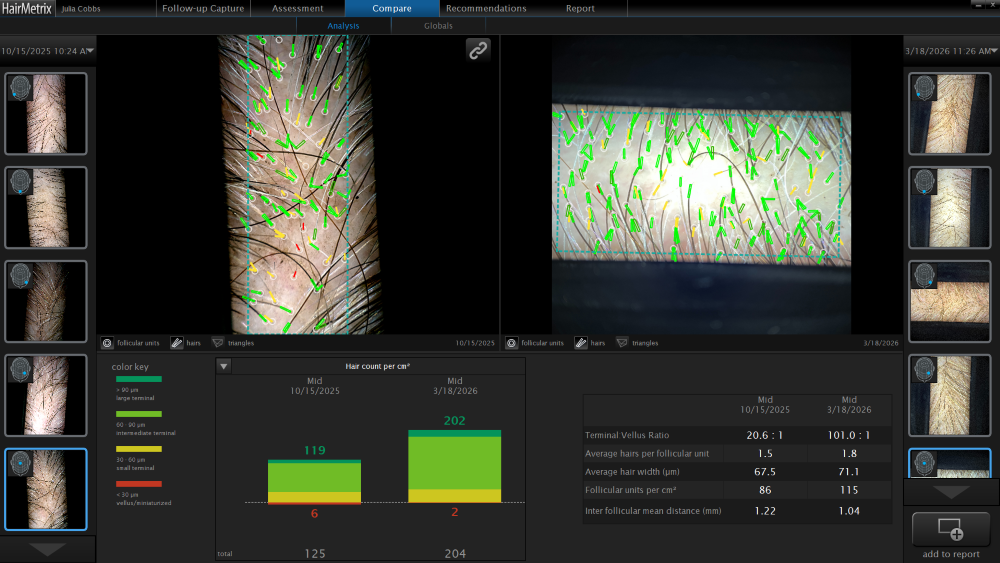
Baseline and Follow-Up Comparison
One of the most valuable uses of HairMetrix is comparison over time. By documenting your scalp at the start of treatment and then scanning again later, HRI can better evaluate whether your plan is helping maintain, improve, or stabilize your hair.
Who Should Consider a HairMetrix Scalp Scan?
A HairMetrix scalp scan may be a good option if you are concerned about hair loss, thinning, shedding, or changes in hair density.
It may be especially helpful for:
- Men with early hairline recession
- Men with crown thinning
- Women with widening parts or diffuse thinning
- Patients considering PRP for hair loss
- Patients considering exosome or growth factor therapy
- Patients using minoxidil, finasteride, dutasteride, or other hair loss medication
- Patients using low-level laser therapy
- Patients considering a hair transplant
- Patients who want to monitor results after starting treatment
- Patients who are unsure whether their hair loss is getting worse
- Patients who want measurable information before committing to treatment
Hair loss is easier to manage when it is measured, documented, and treated early. A HairMetrix scan helps establish that baseline.
HairMetrix for Non-Surgical Hair Loss Treatment Planning
HairMetrix fits naturally into HRI’s non-surgical hair restoration services because non-surgical treatments often work best when they are started before advanced hair loss occurs.
At HRI, your scan may help guide recommendations such as:
PRP Hair Restoration
Platelet-rich plasma therapy may be recommended for patients who still have active follicles and want a non-surgical option to support thicker, healthier-looking hair.
Low-Level Laser Therapy
Low-level laser therapy may be used as part of a broader hair restoration plan to support scalp and follicle health.
Exosome and Growth Factor Therapy
Regenerative therapies may be considered for patients seeking advanced non-surgical options for thinning hair and scalp rejuvenation.
Hair Loss Prevention Products
Physician-formulated hair loss prevention products, topical treatments, and at-home support may be recommended depending on your scan results, history, goals, and candidacy.
Medical Hair Loss Therapy
Some patients may benefit from medical treatment options like Dutasteride Mesotherapy to help slow or stabilize ongoing hair loss.
Hair Transplant Planning
If a scan shows more advanced thinning or permanent density loss, HRI can also discuss whether surgical hair restoration may be appropriate.
Because HRI offers surgical, non-surgical, regenerative, and cosmetic hair restoration options, our recommendations are not limited to a single treatment category. The goal is to match the right solution to the right patient.
What to Expect During a HairMetrix Scalp Scan at HRI
A HairMetrix scan is straightforward, non-surgical, and usually performed before the first and final treatment of your chosen non-surgical therapy.
Consultation and Hair Loss History
We begin by discussing your concerns, timing, family history, previous treatments, health background, and goals. This helps us understand what you are experiencing and what you want to achieve.
Scalp Imaging
Selected areas of the scalp are imaged using HairMetrix technology. These areas may include the frontal hairline, temples, mid-scalp, crown, part line, or other zones where thinning is most noticeable.
AI-Powered Analysis
The HairMetrix system analyzes the captured images and provides quantitative data about your hair and scalp characteristics.
Review of Findings
Your HRI consultant reviews your scan results with you in clear, understandable terms. The goal is to help you understand what the numbers mean and how they relate to your visible hair loss.
Personalized Treatment Recommendation
Based on your scan, goals, history, and candidacy, HRI will recommend a treatment plan. This may include non-surgical therapy, medical prevention, regenerative treatment, cosmetic options, surgical restoration, or a combination approach.
Progress Monitoring
If you begin treatment, follow-up scans can help compare your results over time. The HairMetrix allows us to pinpoint the same parts of the scalp before and after treatment so you can compare apples to apples.
Why Objective Hair Loss Measurement Matters
Hair loss can be difficult to judge by appearance alone. Lighting, hairstyle, hair length, camera angle, wet hair, product use, and even stress can affect how thin hair appears on a given day.
That is why objective measurement is valuable.
A HairMetrix scan helps create a more consistent baseline, so future changes can be compared more accurately. For many patients, this reduces uncertainty. Instead of guessing whether a treatment is working, you can review measurable changes with your HRI team.
This is particularly important for non-surgical hair restoration because results often develop gradually. Some treatments may help reduce shedding first, then improve thickness or density over time. Without a baseline, it can be difficult to know what has changed.
HairMetrix Scalp Scan for Men
Male pattern hair loss often begins with recession at the temples, thinning at the crown, or gradual loss through the frontal and mid-scalp areas. Many men wait until loss is obvious before seeking help, but earlier evaluation often creates more treatment options.
A HairMetrix scan can help men understand:
- Whether the hairline is actively thinning
- Whether crown density is decreasing
- Whether miniaturization is present
- Whether non-surgical treatment may help preserve existing hair
- Whether hair transplant surgery should be considered
- Whether current treatments are producing measurable improvement
For men who are not ready for surgery, HairMetrix can help guide a prevention-focused plan. For men who are considering a transplant, it can help document the current pattern and support more informed planning.
HairMetrix Scalp Scan for Women
Women’s hair loss often looks different from men’s hair loss. Instead of a receding hairline, many women notice diffuse thinning, a widening part, reduced ponytail volume, increased shedding, or more visible scalp under bright light.
A HairMetrix scan can help women evaluate:
- Part-line density
- Diffuse thinning
- Hair shaft thickness
- Scalp coverage
- Changes after shedding episodes
- Treatment response over time
Because women’s hair loss can have multiple contributing factors, a careful consultation is important. HairMetrix provides objective scalp data that can support a more informed discussion about non-surgical options.
Is HairMetrix a Hair Loss Treatment?
No. HairMetrix is not a treatment. It is an advanced scalp analysis and documentation tool.
The scan itself does not regrow hair. Its purpose is to help evaluate your current hair and scalp condition, guide treatment planning, and monitor progress after treatment begins.
Think of it like diagnostic imaging for your hair restoration journey. It helps you and your HRI team make better decisions based on objective information.
How Often Should You Repeat a HairMetrix Scan?
The right timing depends on your treatment plan. Many hair restoration treatments take several months before visible changes can be judged fairly.
For patients beginning non-surgical therapy, HRI may recommend follow-up imaging after enough time has passed to evaluate trends. This helps compare your current results against your original baseline.
Follow-up scans may be useful after:
- Starting PRP
- Starting exosome or growth factor therapy
- Beginning low-level laser therapy
- Starting or changing medication
- Beginning a hair loss prevention program
- Completing a hair transplant
- Noticing new shedding or sudden changes
The goal is not to scan constantly. The goal is to scan at meaningful intervals so your progress can be evaluated more accurately.
Why Choose Hair Restoration Institute of Minnesota?
Hair Restoration Institute of Minnesota is dedicated exclusively to hair restoration. From our Bloomington clinic near Minneapolis, St. Paul, MSP Airport, and the Mall of America, we serve patients across Minnesota and the greater Midwest.
HRI offers a full range of hair restoration options, including:
- Hair transplant surgery
- PRP hair restoration
- Low-level laser therapy
- Exosome and growth factor therapy
- Hair loss prevention products
- Scalp micropigmentation
- Hair replacement and cosmetic solutions
Because we offer multiple approaches, our team can help you compare your options and choose the plan that best fits your level of hair loss, goals, timeline, budget, and lifestyle.
A HairMetrix scan adds another layer of precision to that process.
Schedule a HairMetrix Scalp Scan in Bloomington, MN
If you are concerned about thinning hair, the most important step is to get clear information.
A HairMetrix scalp scan at Hair Restoration Institute of Minnesota can help you understand your hair density, document your baseline, and choose a personalized path forward.
Whether you are just beginning to notice thinning or you have been managing hair loss for years, HRI can help you explore your options.
Hair Restoration Institute of Minnesota
8009 34th Avenue S, Suite 1225
Bloomington, MN 55425
Phone: 612-588-4247
HairMetrix Scalp Scan FAQ
A HairMetrix scalp scan is an AI-powered hair and scalp analysis that uses imaging technology to evaluate hair density, hair count, follicular units, hair shaft thickness, and other scalp characteristics. It helps create a measurable baseline for hair loss treatment planning.
No. HairMetrix scanning is non-surgical and non-invasive. It uses imaging technology to analyze selected areas of the scalp.
No
HairMetrix provides objective scalp and hair measurements, but it is not a standalone medical diagnosis. It is used as part of a broader consultation that may include your history, visible pattern of loss, treatment history, and medical considerations.
HairMetrix may be helpful for men and women experiencing thinning hair, shedding, crown thinning, receding hairlines, widening parts, or reduced density. It is also useful for patients who want to track treatment progress over time.
HairMetrix can help compare baseline and follow-up measurements after PRP or other treatments. This may help determine whether density, hair thickness, or other measurable factors are changing over time.
No. HairMetrix is useful for both surgical and non-surgical hair restoration planning. Many patients use it to evaluate non-surgical options before considering a transplant.
The scan itself is typically quick and can be performed during a hair loss consultation. The full visit includes your consultation, imaging, review of findings, and treatment recommendations.
Hair Restoration Institute of Minnesota offers HairMetrix scalp scanning at its Bloomington clinic near Minneapolis, St. Paul, MSP Airport, and the Mall of America.