


July 24, 2026
Does a Hair Transplant Actually Hurt? What the Wildly Different Answers Are Really Telling You
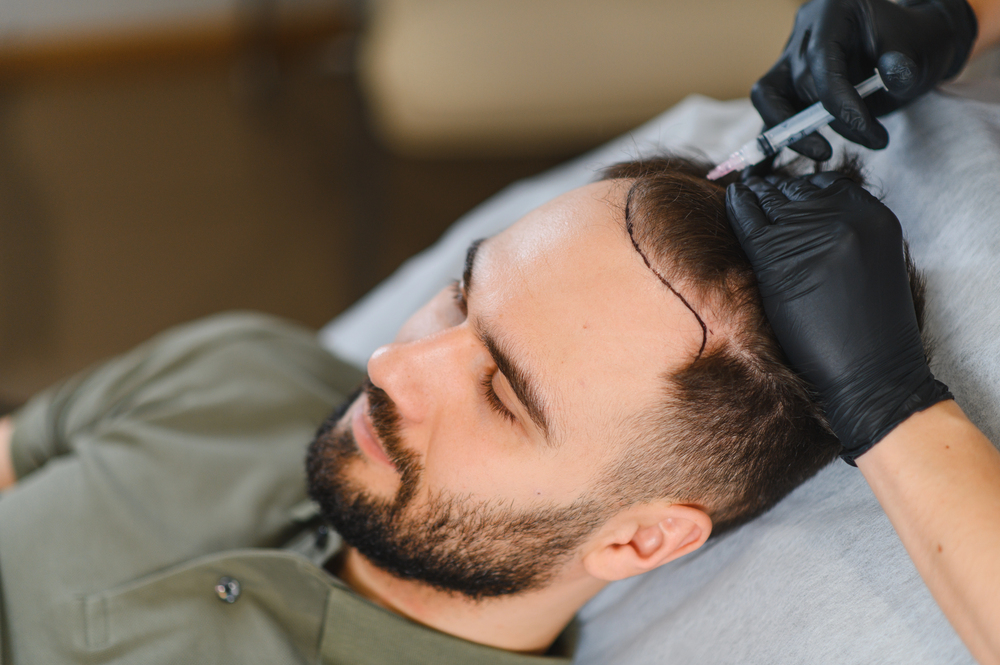
Ask this question in any hair loss forum, and you will get answers ranging from "I fell asleep during it" to "one of the worst experiences of my life." Both people are telling the truth. The reason the answers scatter so violently is that pain during a hair transplant is not one variable it is at least four, and most of them are decided before you sit down in the chair.
If you are trying to figure out what to expect, the useful question is not "does it hurt." It is "which parts hurt, what determines how much, and what can be done about it." Here is the honest version.
The procedure has three distinct pain phases
Phase 1: The anesthetic injections
This is the part that hurts, and essentially everyone agrees on it. Numbing the scalp requires a series of injections along the donor zone and, later, the recipient area. The needles are fine, but the scalp is densely innervated, and the fluid volume itself creates pressure. Most patients describe this phase as sharp and unpleasant but brief, typically five to fifteen minutes per region.
Phase 2: Extraction and implantation
If the anesthetic is working properly, this phase should be boring, not painful. Patients routinely read, watch films, or sleep through hours of it. What people do report is positional discomfort: a stiff neck from hours face-down during extraction, a sore back, and the tedium of sitting still. That is fatigue, not pain, and it is why long single-day cases are physically draining even when they are entirely comfortable.
Phase 3: The first few nights
The donor area is typically the sore part afterward, and sleeping is the main complaint most patients are told to sleep elevated for several nights. Swelling of the forehead around days two to four is common and painless but startling. Most people describe post-operative discomfort as manageable with the medication their clinic provides.
Why some patients feel everything
When someone reports genuine intra-operative pain feeling the punch, feeling grafts being placed the anesthetic has failed, and there are identifiable reasons why.
Anesthetic technique
There is a real technical difference between infiltrating local anesthetic broadly across the scalp and performing targeted nerve blocks of the supraorbital, supratrochlear, occipital, and auriculotemporal nerves before tumescent infiltration. A block anesthetizes the whole territory a nerve supplies, rather than relying on saturating tissue. Comparative work on scalp procedures has found regional nerve blocks produce significantly less pain than ring blocks. A clinic that routinely uses blocks plus tumescent anesthesia is doing something meaningfully different from one that simply injects lidocaine into the field.
Anesthetic pharmacology and duration
Plain lidocaine has a working duration of roughly one to two hours. Adding epinephrine extends that substantially and also reduces bleeding. Longer-acting agents such as bupivacaine are used in some protocols precisely because a six- to nine-hour case will outrun plain lidocaine several times over. Reviews of anesthesia in hair transplantation describe layered protocols combining blocks, tumescent field anesthesia, and long-acting agents for exactly this reason. If a patient reports the numbing "wore off in five minutes," the far more likely explanations are technique and formulation than an exotic metabolic quirk.
Individual variation is real but smaller than people assume
Some patients genuinely do require more anesthetic than average, and a subset of people have inherited differences in how they respond to local anesthetics. If dental work has consistently been painful for you despite numbing, that is a meaningful signal, and you should raise it before surgery rather than during it. But "I metabolize lidocaine fast" is also the explanation patients reach for when the real problem was under-dosing or a clinic reluctant to stop and re-inject.
Case length and staffing
A case spread over three or four days, or one run without adequate surgical assistance, extends the total time you spend under anesthetic and multiplies the number of re-numbing cycles. Most modern large sessions are completed in one long day or two, with a trained team working in parallel. Multi-day cases are not automatically bad, but they should be a deliberate clinical decision explained to you in advance, not something that emerges because the procedure is running behind.
Pain also tracks bleeding, and bleeding tracks preparation
Patients who report severe pain very often also report heavy bleeding, and the two are connected. Pain raises blood pressure, higher blood pressure increases bleeding, bleeding slows the surgeon, and a slower case means more time and more anesthetic. Preparation genuinely matters here: following instructions on alcohol, blood thinners, anti-inflammatories, and supplements in the weeks beforehand is not clinic boilerplate. Uncontrolled hypertension is worth addressing before scheduling, not after.
What to ask before you book
These questions separate clinics more effectively than before-and-after galleries do:
What anesthetic protocol do you use nerve blocks, tumescent, or both? Which agents, and how long do they last? What happens if I feel something mid-procedure: is there a defined process for stopping and re-dosing? Do you offer oral anxiolytics or IV sedation, and is an anesthesia professional present if so? How long will my case take and how many staff will be working? And, plainly: what percentage of your patients report significant pain?
A clinic that answers these specifically is one that has thought about them. A clinic that answers "it's painless" has not.
The realistic expectation
For a well-anesthetized patient at a properly staffed clinic, a hair transplant should involve one genuinely uncomfortable stretch of injections followed by hours of boredom and stiffness, then a few nights of awkward sleeping. That is the median experience, and it is why so many patients come back for a second procedure. The horror stories are real, but they are overwhelmingly stories about anesthetic technique, case management, and staffing, not about hair transplantation as a procedure.
Which means the pain question is, in the end, another version of the surgeon-selection question. Choose for technique and team, and the pain issue largely takes care of itself.
Have questions about what the day actually looks like? Hair Restoration Institute of Minnesota offers a free consultation where we walk through the anesthetic protocol, the timeline, and recovery for FUE and FUT before you commit to anything and for patients traveling in from out of state, our Hair by Air program helps with the logistics. More at www.HRIMN.com.
