


August 14, 2026
When Can You Cut, Buzz, or Fade Your Hair After a Hair Transplant?
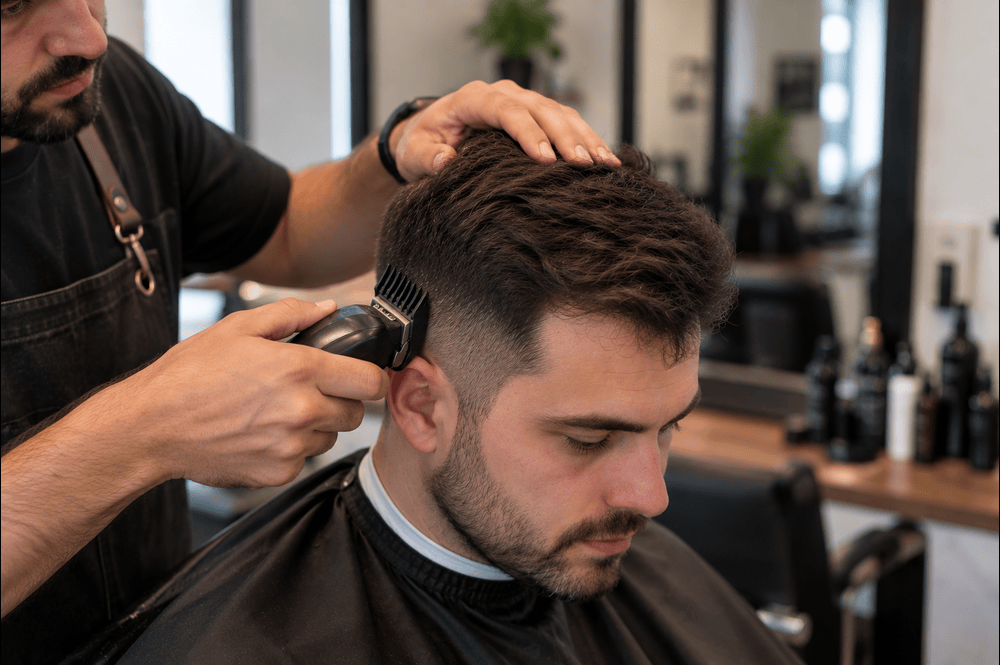
Three weeks after surgery, you have to go back to work, you hate how your head looks, and you want to take clippers to it. So you ask online and get four answers: wait three months, my doctor said four weeks was fine, I did it at day 21 with no problem, and absolutely nothing on the recipient area for six months.
All four of those answers are being given as though they answer the same question. They do not. There are two entirely separate risks in play, they resolve on completely different timelines, and once you separate them the confusion mostly disappears.
Risk one: dislodging a graft
This is the risk everyone is actually worried about, and it is the one that resolves fastest. A newly placed graft sits in a recipient site held initially by fibrin, then progressively locked in as the wound heals around it.
The timeline has been measured. In the classic graft anchoring study in hair transplant surgery, pulling on a transplanted hair in the first two days reliably dislodged the graft. By day six, pulling on the hair no longer dislodged it. By day nine, grafts were no longer at meaningful risk of being pulled out at all. Most surgeons build in a safety buffer and treat days ten through fourteen as the point where grafts are fully secure.
That is the real answer to "can I cut my hair." After roughly two weeks, a clipper with a guard passing over the recipient area is not going to pull a graft out. The follicle is below the skin; the guard never touches it; and the shaft itself is no longer a handle you can pull the graft out by.
Risk two: not being able to see what you have
This is the risk that generates the "wait three to six months" advice, and it has nothing to do with graft survival.
Transplanted hairs shed within the first few weeks, sit dormant, and start emerging around months three to four. When they emerge they are fine, short, and often lighter in color than they will eventually be. Two things then happen over the following year: the shafts thicken, and they get longer. Both contribute to perceived density.
If you buzz the recipient area every few weeks during that window, you keep resetting the length clock. You never accumulate enough length for the new hairs to lie together and create the illusion of coverage, and you cannot compare your progress photos month to month because the variable you are measuring keeps changing. People in this situation conclude their result failed when what actually happened is they never let it grow long enough to look like anything.
That is a cosmetic and psychological argument for patience, not a surgical one, which is why it is stated in months while the graft-security answer is stated in days.
Donor area and recipient area are different
The donor zone at the back and sides has no transplanted grafts in it. It has healing extraction sites, and after FUE those are tiny punch wounds; after FUT it is a linear closure. Once the surface has healed, typically within a couple of weeks, the donor area can be clipped on a normal schedule. Many patients keep the donor area tidy while leaving the top alone, which is a reasonable compromise if you are trying to look presentable at work.
One caution specific to FUE: very short fades can expose the pattern of extraction sites as pale dots, particularly in patients with high hair-to-skin contrast. That is a cosmetic issue rather than a healing one, and it is usually addressed with a slightly longer guard or, if it persists, with scalp micropigmentation to reduce the contrast.
Practical guidance by timeline
Days 0–10. Nothing mechanical on the recipient area. No clippers, no scissors, no brushing, no razor. Follow your clinic's washing protocol precisely, which typically means gentle pouring rather than direct water pressure for the first week.
Days 10–21. Grafts are secure. The donor area can be clipped. Most surgeons still prefer you leave the recipient area alone through this window while crusting fully resolves and the skin settles.
Weeks 3–8. Clipping the recipient area with a guard is generally safe from a graft-survival standpoint. Use a guard, not a bare blade, apply no pressure, and make sure the clippers are clean. Many clinics are comfortable at four weeks; some are more conservative. Ask yours — this is the one question where your own surgeon's protocol beats a forum consensus, because they know how your specific case was placed.
Months 3–8. This is the window where cutting costs you visible progress rather than grafts. If you can tolerate it, scissor-trim rather than clip the top, and keep the sides faded so the overall shape looks intentional.
Month 8 onward. Cut it however you like. Transplanted hair behaves like the donor hair it came from.
What to tell your barber
Tell them you have had a hair transplant and when. Ask for a guard on the top rather than a bare blade or razor over the recipient area, ask them not to use a straight razor on the hairline, and ask them to go slow and not press. A competent barber will have no problem with any of this. If you are within the first month, ask them to work on the sides only.
Getting through the ugly-duckling phase
The visible awkward window realistically runs from around week two, when shedding sets in, to around month five. It is uncomfortable, and buzzing everything to a uniform short length is a legitimate coping strategy a shaved-looking head reads as a deliberate style choice, whereas a patchy half-shed recipient zone reads as something is wrong. If you buzz once at week four to get through a return to work and then leave it alone, you have not harmed your result.
What harms your result is buzzing repeatedly through months four to eight and then judging the outcome. Pick one approach and hold it.
The takeaway
Grafts are secure in about ten days. Everything after that is about whether you want to be able to see your result. Those are two different questions, and almost every contradictory answer you will read online is somebody answering one of them while thinking they are answering the other.
If your clinic gave you a specific post-operative protocol, follow it accounts for details of your case that a general timeline cannot. If your clinic gave you no guidance at all on this, that is worth noticing on its own.
A note from us
Aftercare guidance should be specific, written down, and available to you months after your procedure, not something you have to crowdsource at week three. The Hair Restoration Institute of Minnesota offers a free consultation for anyone considering a hair transplant, including patients treated elsewhere who have questions about their recovery. More at hrimn.com.
