


August 07, 2026
Does Topical Finasteride Actually Work? What the Research Says About Topical vs. Oral
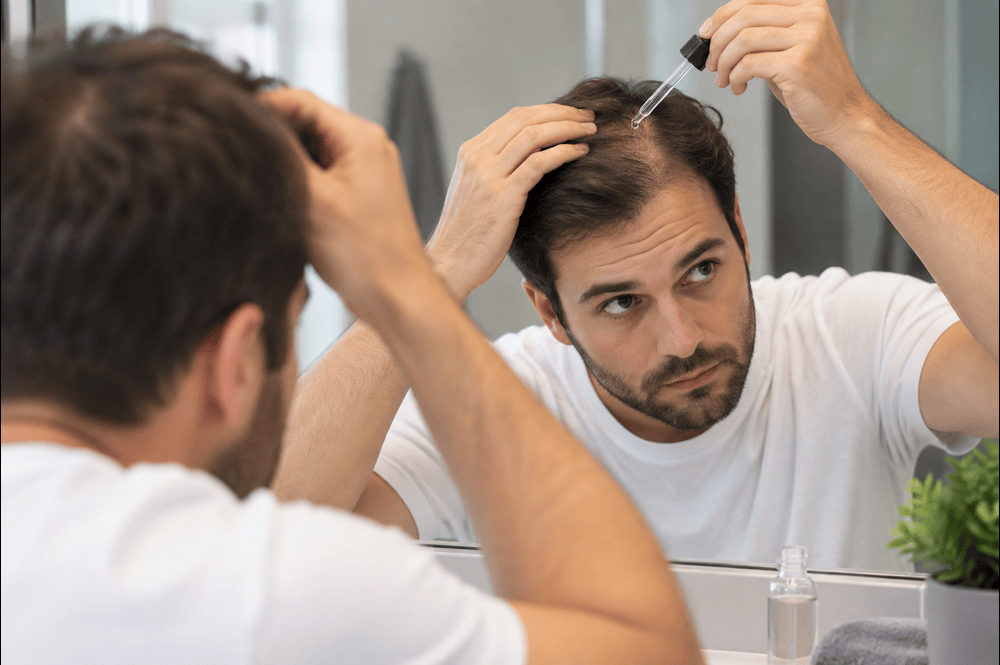
Every few weeks, somebody posts a two-year topical finasteride update showing lost ground at the temples, and the replies split immediately: half the thread says topical is a waste of time, and you should have been on oral from day one, the other half says it has worked beautifully for them, and the poster must be doing something wrong. Both camps are arguing from a sample size of one.
The clinical data on topical finasteride is actually better than most of these threads assume, and it also explains why two people using what sounds like the same product get opposite outcomes. Here is what is established, what is genuinely variable, and how to tell whether topical is failing you or whether something else is going on.
What topical finasteride is supposed to do
Male pattern hair loss is driven by dihydrotestosterone (DHT), which is produced when the enzyme 5-alpha reductase converts testosterone. Finasteride inhibits that enzyme. Taken orally, it lowers DHT throughout the body, which is why it works and also why a minority of men report systemic side effects.
The idea behind a topical formulation is to inhibit 5-alpha reductase in the scalp, where you want the effect, while keeping the drug largely out of general circulation, where you do not. That is a reasonable goal on paper. The question has always been whether enough drug reaches the follicle to matter, and whether it truly stays local.
What the trial data shows
The most useful study is a phase III randomized controlled trial of a 0.25% topical finasteride spray that compared it head-to-head against 1 mg oral finasteride and placebo over 24 weeks. Two findings matter.
First, efficacy was comparable. Change in target-area hair count from baseline was roughly 20 hairs per square centimeter for topical versus roughly 21 for oral, a difference small enough that, over six months, the two arms were effectively performing the same job.
Second, systemic exposure was not comparable at all. Peak plasma concentrations of finasteride were more than a hundred times lower with topical, and the drop in serum DHT was about 35% with topical versus about 56% with oral. That gap is the entire clinical argument for topical: similar scalp benefit, meaningfully less systemic androgen suppression.
A separate randomized comparison of 0.25% topical finasteride with and without 5% minoxidil found the combination outperformed either agent alone — which is the same story that has held for oral finasteride for twenty years. The drugs address different mechanisms and stack.
So why does it fail for some people?
The dose delivered is far less consistent than a tablet
A tablet is a fixed quantity. A spray or a compounded solution is not. Actuation volume varies as a canister empties, compounded formulas vary between pharmacies, concentrations range from 0.01% to 3% across products people are actually using, and application technique how much scalp is covered, whether the solution is left on for the recommended several hours before washing, and whether the hair is dry changes absorption substantially. Two people saying "I'm on topical fin" may be receiving very different daily doses.
Partial DHT blockade may not be enough for your rate of loss
Roughly 35% systemic DHT reduction is a meaningful signal, but if you are a fast progressor with aggressive genetics, partial blockade can slow loss without stopping it. This is the single most common explanation for the "it worked, and then it didn't" pattern. The medication was never producing regrowth; it was reducing the slope of a line that was still pointing down.
The temples are the hardest zone on the scalp
Temple and corner recession responds worse to every medical therapy than the crown and mid-scalp do. Studies of medical therapy consistently show the strongest measurable response at the vertex. If your only complaint after two years is temple recession while the rest of your scalp is stable, that is closer to an expected outcome than a treatment failure.
Absorption and responder variability are real
Skin permeability differs between individuals, and adjuncts people add tretinoin, microneedling measurably change how much drug gets through. Some of the disagreement in these threads is not disagreement at all; it is two different absorption profiles being described in identical language.
How to tell whether topical is actually failing you
Impressions are unreliable, and comparison photos taken in different lighting and at different hair lengths are worse than useless. Before concluding anything:
Take standardized photos with the same overhead lighting, same hair length, same angles, every three months. Most of the "it stopped working" posts are comparing a harsh-overhead-light photo today with a flattering side-lit photo from two years ago.
Give any formulation twelve months before judging it. Six months is the earliest point at which a trend is readable, and twelve is when it is reliable.
Ask whether you are below your starting point or simply not above it. Maintenance is the realistic goal for most men on any DHT blocker. Regrowth is a bonus, and it is far more likely in miniaturized areas than in slick-bald ones.
Consider whether anything else changed significant weight loss, illness, a new medication, or a major stressor can produce shedding that has nothing to do with your hair loss protocol.
If it genuinely is not holding
Losing ground on topical finasteride is not the end of the medical options; it usually means the blockade needs to be stronger, better absorbed, or supported. Reasonable next steps, all of which should be discussed with a physician who treats hair loss rather than assembled from a forum thread, include moving to oral finasteride, moving to dutasteride, which inhibits both type I and type II 5-alpha reductase, or adding minoxidil if you are not already using it. Topical dutasteride is also under active study, though it is not yet a standard-of-care option.
There are also non-hormonal routes for people who cannot or will not take a systemic DHT blocker. Low-level laser therapy, platelet-rich plasma, and growth factor and exosome-based therapies all work through mechanisms unrelated to androgen suppression. Their evidence bases differ in strength. PRP has the most supportive randomized data of the three, and a recent review of regenerative therapies for pattern hair loss is candid about where the evidence is still thin, but they are legitimate additions for someone who has exhausted their tolerance for hormonal treatment.
And if recession has already progressed past what any medication can reverse, a hair transplant moves permanent donor follicles into the thinned zone. That is a separate decision, and the medication conversation still matters afterward: transplanted hair is DHT-resistant, but the native hair around it is not.
The honest summary
Topical finasteride is a real treatment with real phase III data behind it, not a placebo and not a scam. It performs close to oral finasteride on hair count while suppressing systemic DHT roughly 40% less. What it cannot do is overcome an aggressive rate of loss on its own, deliver a consistent dose the way a tablet does, or rescue temples that are already well past miniaturization. When someone says it failed them after two years, all three of those are more likely explanations than "topical doesn't work."
The most useful thing you can do is stop evaluating your protocol from photographs and start evaluating it from measurements taken under consistent conditions, with a clinician who can look at what is actually happening at the follicle level.
A note from us
If you are unsure whether your current treatment is holding, the Hair Restoration Institute of Minnesota offers a free, no-pressure consultation that includes a scalp evaluation and a look at whether your medical regimen is doing what you think it is. You can learn more or book a time at hrimn.com or schedule online.
