


July 08, 2026
Hair Systems for Beginners
Hair Systems for Beginners: How They Stay On, Maintenance, and What to Expect
Hair Restoration Institute of Minnesota | Educational Guide
Quick answer: Modern hair systems can be worn with daily-removal tape, longer-wear adhesive, clips, or no adhesive depending on the system. When properly fitted and maintained, they are designed to stay secure during ordinary daily activity. The main tradeoffs are recurring servicing, scalp care, replacement cost, and choosing an attachment method that suits your skin and lifestyle.
Hair systems are having a moment. Threads about men openly wearing them draw hundreds of supportive comments, and a well-made modern unit is now good enough that even people who know to look often cannot tell. If you have been quietly curious, you probably have the same practical questions everyone asks: how does it stay on, will it come off at the worst possible moment, how much maintenance is involved, and how on earth do you start wearing one to work? Here is a straightforward guide.
What a modern hair system actually is
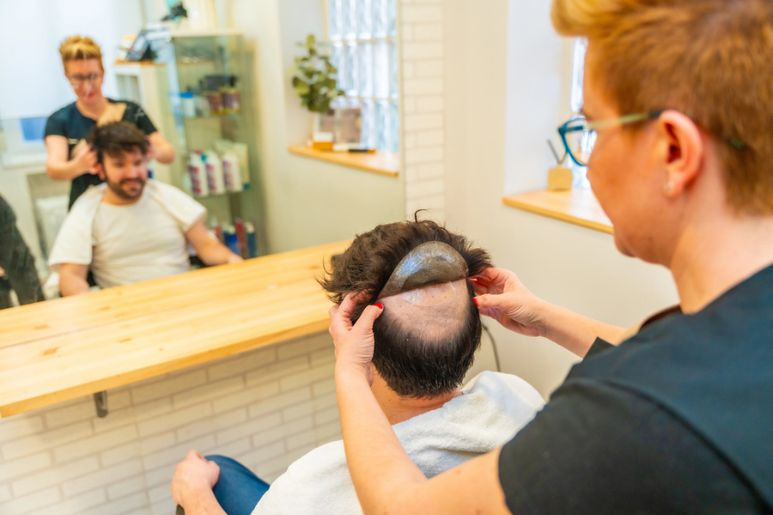
The word covers a range of products, from a small patch that adds density to a full-cap unit that pulls on like a very realistic wig. A quality hair system (sometimes called a hair replacement system, unit, or hairpiece) is a thin, breathable base, usually a fine lace or polymer skin, hand-tied with human or high-grade synthetic hair and cut to match your color, density, and hairline. This is a long way from the shiny, obvious toupees of decades past, which is a big reason attitudes are shifting.
How they stay on: tape, glue, or clips
There are three common attachment approaches. Perimeter tape uses double-sided strips around the edge of the base; it is quick, forgiving, and popular for people who take the unit off nightly. Liquid adhesive ("glue") bonds the base to the scalp for a stronger, longer hold measured in weeks. Some full-cap units simply pull on with no adhesive at all. A helpful primer on the differences between tape and glue is worth reading before you commit to a routine.
The right choice is mostly about lifestyle. If you want to remove the system every night, low-tack daily-wear tape is comfortable and easy to clean up. If you would rather bond it and forget it for a couple of weeks, a stronger adhesive makes sense, with professional servicing in between.
Will it come off unexpectedly?
A properly bonded system does not fall off during normal daily life, exercise, or weather. The horror stories almost always involve either a no-adhesive cap that was pulled off, or a bond that was overdue for maintenance. Most wearers have the unit professionally cleaned, re-bonded, and the hairline refreshed every three to five weeks. Treat that appointment like a haircut and the security question largely takes care of itself.
Taking care of your scalp
Skin health matters more than beginners expect. Adhesives and tapes sit against your scalp for hours, so anyone with sensitive skin, eczema, or a tendency toward an itchy scalp should choose hypoallergenic products and let the skin breathe. A good guide to adhesives and skin conditions is a smart read. If you ever notice irritation, the standard advice is to remove the system daily and let the scalp recover fully rather than pushing through.
HRIMN offers all these services to suit any client:
The hardest part is social, not technical
For most people the real hesitation is not adhesive, it is walking into work on Monday with a full head of hair. The community consensus is remarkably consistent: own it rather than hide it. Telling a couple of trusted coworkers plainly ("I started wearing a hair system, figured you would rather hear it from me") defuses the awkwardness far better than hoping no one notices. And the honest truth is that most people are not studying your hairline; a good unit simply reads as "got a haircut." The anxiety is almost always bigger than the reality.
Is a system right for you, or is something else?
A hair system is immediate, non-surgical, and completely reversible, which makes it a great fit if you want hair tomorrow, are not a surgical candidate, or simply like the flexibility. It is worth knowing the alternatives so you choose with open eyes. A hair transplant uses your own hair for a permanent result but takes about a year to fully grow in, and scalp micropigmentation creates the look of a closely shaved head without adding length. None of these are mutually exclusive, and plenty of people combine them.
The bottom line
A modern hair system is more secure, more comfortable, and more natural than its reputation suggests, and the biggest barrier is usually confidence rather than logistics. Start with a daily-wear setup, get professional help with fitting and the hairline, look after your scalp, and give yourself a few weeks to adjust. Most wearers say the same thing afterward: they wish they had stopped worrying about it sooner.
About HRIMN. The Hair Restoration Institute of Minnesota fits custom hair systems and also offers surgical restoration, so our consultations start with what fits your goals rather than what we happen to sell. If you would like to see and feel a modern unit in person and talk through the options, we offer a free, no-pressure consultation. Learn more at www.HRIMN.com or schedule a consultation online.
Written by: Laura Reed, Hair Replacement Department Manager, Hair Restoration Institute of Minnesota
Medically reviewed by: Dr. Gary Petrus, MD, Medical Director
