


July 07, 2026
Does Transplanted Hair Stay Coarse and Wiry Forever? What to Expect From Texture Changes
Does Transplanted Hair Stay Coarse and Wiry Forever?
Hair Restoration Institute of Minnesota | Educational Guide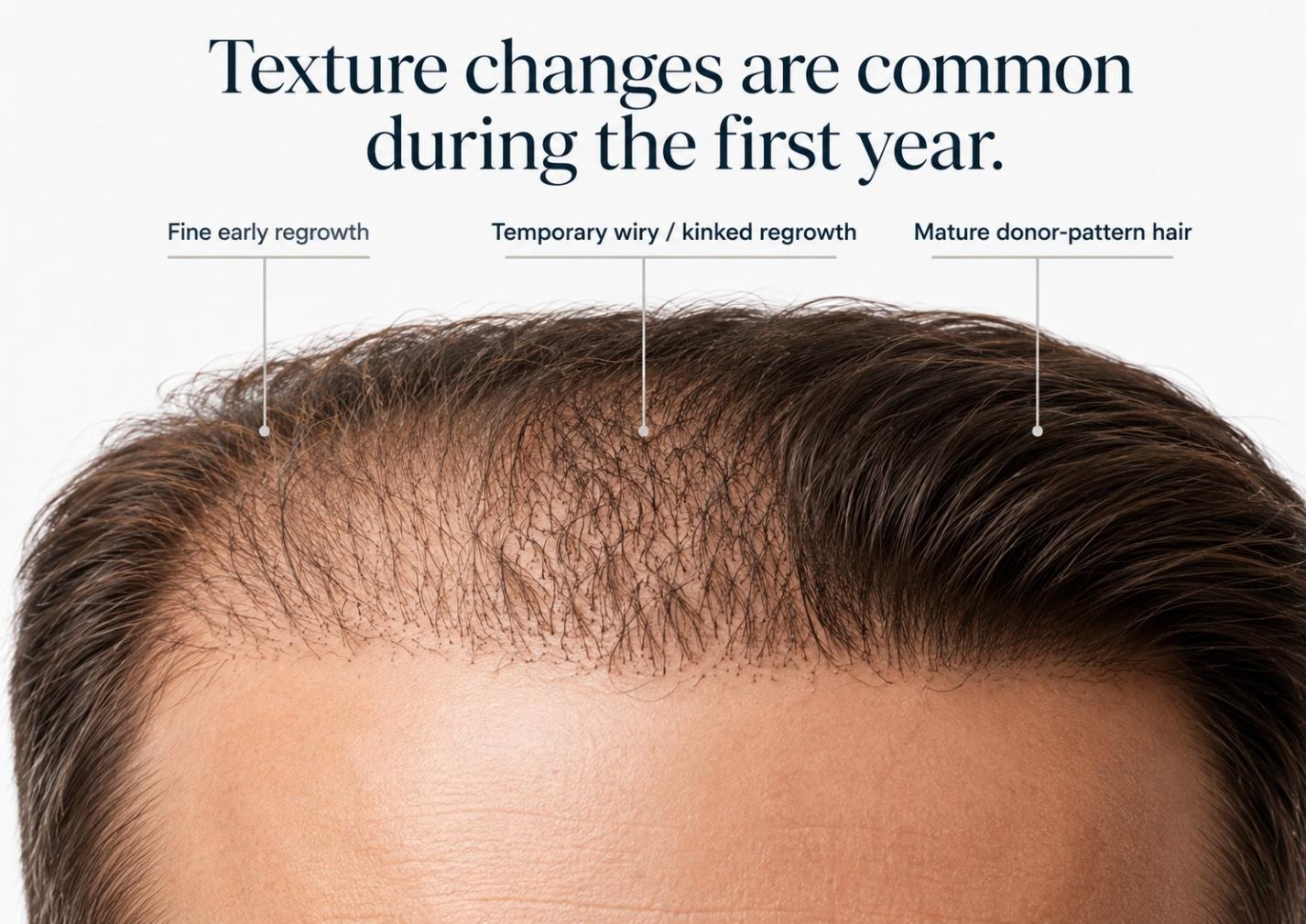
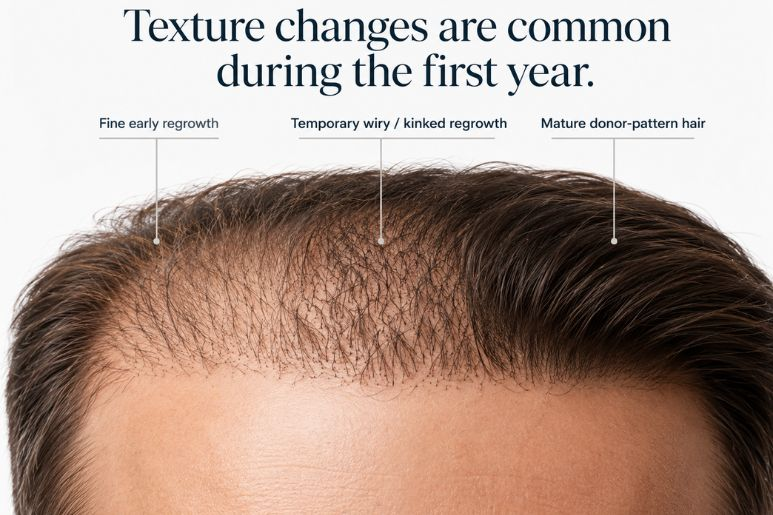
If you scroll the hair-restoration forums long enough, you will find some version of the same worried post: eight months out from surgery, the new hair looks great in photos, but it feels dry, coarse, wiry, and sometimes almost curly or kinky when it dries. The advice that follows is all over the map. Some people swear it goes back to normal, others insist it is permanent, and a few offer confident theories that are simply wrong. Here is what the biology actually tells us.
Why transplanted hair often feels different at first
In the months after a transplant, the recipient area is still healing and the relocated follicles are recalibrating to their new home. Newly regrown hairs frequently emerge fine and then thicken with each growth cycle, and the first hairs to push through healing skin can come in slightly kinked or bent. Add in the temporary shedding that follows almost every procedure, and the coat of hair you feel at 6 to 10 months is genuinely not the finished product.
This early awkward phase overlaps with what surgeons call shock loss, a temporary shedding of transplanted and sometimes surrounding native hairs that is a well documented and usually self resolving part of recovery (see this review of follicular unit excision outcomes). Because so much is changing at once, texture judgments made before roughly 12 months are premature.
The key concept: donor dominance
Modern hair transplantation rests on a principle called donor dominance, first described by Dr. Norman Orentreich in the 1950s and central to the field ever since (a good plain overview lives in the ISHRS history of hair restoration). Follicles moved from the permanent zone at the back and sides of the scalp keep the genetic characteristics of that donor site no matter where they are placed.
This is what makes a hair transplant permanent, but it has a texture consequence people rarely hear about beforehand. Donor hair from the back of the head is often naturally a little coarser, thicker, or wavier than the fine, miniaturized hair it is replacing on top. So as the transplant matures it does not revert to the soft, thin texture you had on your crown years ago. It settles into the texture of your donor hair, which is the hair that was always going to be there.
So does the coarse, wiry feeling go away?
For most people, the harsh, straw-like feel of the early months softens substantially. As the follicles complete two to three full growth cycles, hair caliber evens out, the kinking from healing resolves, and the hair lies and behaves more predictably. Realistically that means noticeable improvement from roughly month 8 to month 18, with the true final texture at around 12 to 18 months.
Medications can influence how the hair feels along the way. Many patients stay on finasteride and minoxidil to protect their native hair, and minoxidil in particular can temporarily change how hair feels as it shifts growth phases. That is normal and not a sign anything is wrong.
When texture genuinely stays coarser
Honesty matters here: for a subset of patients, especially those whose donor hair is naturally coarse, curly, or kinky, the transplanted hair will remain coarser than the surrounding hair long term. It becomes softer and far more manageable than it was at month eight, but it may never feel identical to fine native hair. This is a feature of donor dominance, not a complication, and it is usually very stylable with the right approach.
What actually helps in the meantime
A few simple, evidence-friendly habits make the awkward phase easier. Use a separate conditioner rather than a two-in-one, and consider a leave-in conditioner or a light natural oil on towel-dried hair to combat the dryness that drives the coarse feeling. Keep heat styling gentle while the follicles mature. Most importantly, resist the urge to constantly touch, scrutinize, or restyle the area, which only heightens the anxiety without changing the outcome. Time is doing most of the work.
When to check in with your surgeon
Texture change on its own is almost never a red flag. But if coarse or wiry hair is paired with patchy growth, ongoing thinning of the transplanted zone past a year, visible scarring, or scalp discomfort, that is worth a conversation with the clinic that did your procedure, or a second opinion. Those symptoms point to graft survival or technique questions rather than the normal texture maturation described here. Techniques like follicular unit extraction have their own healing signatures your surgeon can walk you through.
The bottom line
Coarse, dry, wiry, even slightly curly transplanted hair in the first year is extremely common and largely temporary. It softens and settles as the follicles complete several growth cycles, though it will match your donor hair rather than the finer hair you may remember. Patience through the 12-to-18-month window is the single most useful thing you can do.
About HRIMN. The Hair Restoration Institute of Minnesota is a physician-led clinic in the Twin Cities offering surgical and non-surgical hair restoration. If you are weighing a transplant and want a candid assessment of your donor hair and what your realistic result and texture would look like, we offer a free, no-pressure consultation. Learn more at www.HRIMN.com or schedule a consultation online.
Clinical review and sources
This article was written for general education and medically reviewed by Dr Kuldeep Singh, Hair Transplant Surgeon on July 7, 2026. Hair transplantation outcomes and recovery timelines vary by patient, donor hair characteristics, procedure technique, medications, and healing response.
Key references include the International Society of Hair Restoration Surgery’s educational history of donor dominance, peer-reviewed literature on donor-area biology and temporary recipient-site shedding, and published reports describing uncommon persistent kinky or severely curly post-transplant hair changes.
This information is not a substitute for individualized medical advice. Patients with persistent patchy growth, scalp discomfort, visible scarring, or worsening thinning should contact their operating clinic or seek evaluation from a qualified hair-restoration physician.
