


September 15, 2026
Body Hair Transplants Using Beard and Chest Hair
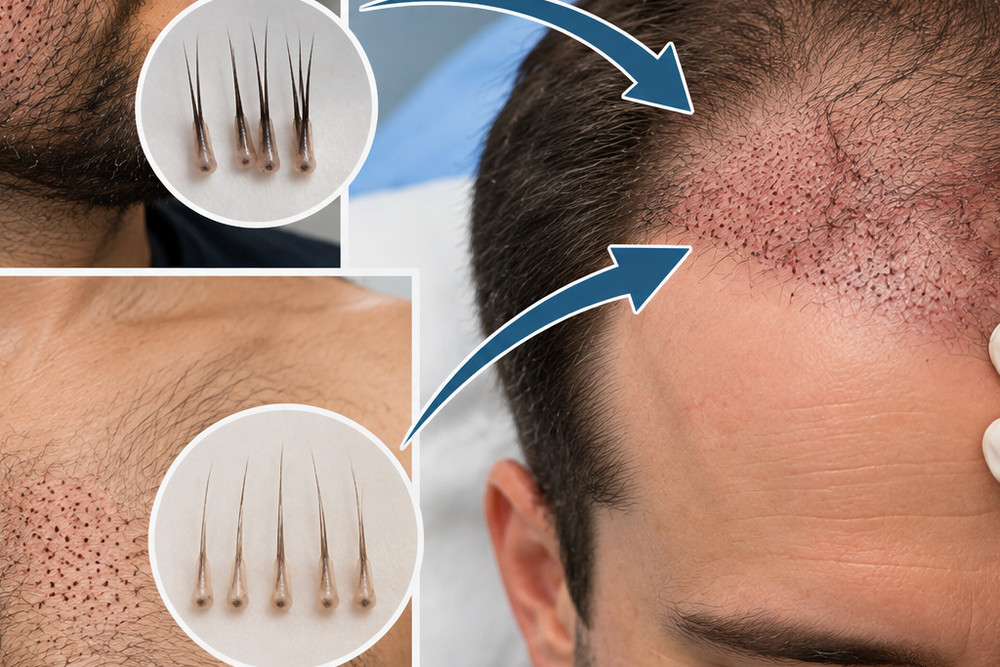
Can beard or chest hair be transplanted to your head? For some patients, yes. When hair loss is extensive or previous procedures have used much of the available scalp donor hair, body hair may provide additional follicles for restoration.
The important qualification is that body hair behaves differently from scalp hair. Its texture, growth cycle, and placement all influence the result.
Understanding which donor hair is suitable, where it belongs, and what it can realistically achieve helps you decide whether a body hair transplant fits your goals. Hair transplantation can also work in the other direction, using scalp hair to restore beards, mustaches, and eyebrows.
For more information, watch the Above the Hairline episode with Dr. Gary Petrus below, covering body hair transplants and beard, mustache, and eyebrow restoration.
Why scalp donor hair can run out
A hair transplant redistributes existing follicles. It does not create new ones. For most scalp transplants, the donor area is the back and sides of the head, where hair is generally more resistant to pattern hair loss.
That supply is limited. The amount a surgeon can safely harvest varies with donor density, hair characteristics, previous procedures, and the need to preserve an acceptable appearance in the donor area. A patient with advanced hair loss may need more coverage than the remaining scalp hair can provide.
Body hair transplantation can sometimes extend that supply. It is especially relevant when someone has extensive baldness, a depleted donor area, or needs additional coverage after earlier surgery. Scalp hair remains the preferred source when it is suitable and available.
Why beard hair is often the next donor source
Beard hair is often the first body donor source considered when scalp hair is limited. For a patient with a dense beard, hair below the jawline may provide additional grafts without harvesting more from the scalp.
Beard hair is often coarser than scalp hair. That thickness can help create the appearance of greater fullness, especially when the grafts are blended with scalp hair in the middle of the scalp or crown.
The same characteristic affects where the hair belongs. Coarse, wiry beard hair can look out of place along a soft frontal hairline. It is generally used farther back, where it can contribute coverage while scalp hair shapes the front.
A thin or patchy beard offers less useful donor hair. Planning also needs to account for how harvesting will change the beard itself. The goal is to improve the scalp while preserving an appearance the patient is comfortable with in the donor area.
When chest and abdominal hair may help
Chest and abdominal hair are other possible sources, particularly for patients with substantial hair in those areas. Chest hair can be softer than beard hair and, in selected patients, may have a role closer to the front of the scalp.
However, chest hair is not interchangeable with scalp hair. Its growth cycle, length, texture, and transplant performance can differ. Having a hairy chest does not automatically mean that its follicles will produce the coverage or hairstyle you want.
Arm and leg hair are generally less useful for scalp restoration because of their growth characteristics and less reliable transplant performance. They are not routine donor sources for these procedures at HRI. Donor selection depends on the quality and suitability of the hair in each area.
What transplanted body hair will look like
A follicle usually retains important characteristics of the area it came from. This is often called donor dominance. Beard hair moved to the scalp may remain thicker or curlier, and chest hair may retain a shorter growth pattern.
Some transplanted hair may change over time, but patients should not count on body hair becoming identical to scalp hair. A realistic plan starts with the hair you actually have.
That is why blending and placement matter so much. Two patients receiving the same number of grafts may have different cosmetic results because their donor hair differs in thickness, curl, color, and growth behavior. The useful question is how those particular grafts will contribute to your desired result.
How body hair transplantation works
Body hair transplantation typically uses follicular unit excision, or FUE. The surgeon removes individual follicular units with a small punch and places them in carefully planned recipient sites.
Harvesting from the beard or chest requires adjustments to the technique used on the scalp. Skin mobility, follicle depth, and the path of a curly follicle can make extraction more challenging. The team must remove an intact graft while limiting injury to the surrounding tissue.
Some cases combine scalp and body donor hair in the same procedure. Larger cases require careful planning of procedure length and local anesthetic dosing. Those details depend on the patient and the areas being treated.
Risks and expectations to discuss
Body hair transplantation is surgery. The consultation should cover infection, ingrown hairs or folliculitis, temporary shedding, scarring, and the possibility that some grafts will not grow as hoped. FUE uses small incisions, but it is not scar free.
Beard harvesting also requires an understanding of the anatomy around the jawline. Local anesthesia can temporarily affect lower lip movement, and the surgeon must understand the nearby facial nerve anatomy. Temporary anesthetic effects and injury are different issues; patients should ask how the team reduces risk and evaluates unexpected symptoms.
Ask to see results from patients with comparable donor hair and hair loss. Discuss the expected change in the donor area, achievable coverage, cost, and whether more than one procedure may be needed. Body hair can expand the options for selected patients, but it cannot guarantee a full head of hair.
Using scalp hair for beards and eyebrows
Hair transplantation can also work in the other direction. Scalp follicles may be used to fill a patchy beard, restore a mustache, or rebuild thinning eyebrows.
These procedures require careful attention to direction and angle. Eyebrow hairs follow changing patterns across the brow, while beard and mustache hairs need to blend with the surrounding facial hair. Placement helps determine whether the result looks natural.
Scalp hair transplanted to the face can continue growing like scalp hair. Eyebrow patients, in particular, should expect ongoing trimming. Even if the hairs become easier to manage over time, regular grooming should remain part of the plan.
Facial hair restoration also uses a finite donor supply. If you may need scalp restoration later, that possibility belongs in the discussion before committing follicles to a beard or eyebrow procedure.
Explore your options at HRI in Minnesota
If you have been told that your scalp donor area is limited, a consultation can help determine whether beard or chest hair changes your options. If surgery is unlikely to meet your goals, scalp micropigmentation or a hair system may offer a more suitable approach.
Hair Restoration Institute of Minnesota offers free consultations for patients considering scalp and facial hair restoration. Tell us about any previous procedures and the result you want so we can discuss a plan that fits your donor supply.
Schedule your free consultation. Traveling from outside the Twin Cities? Visit our Hair by Air program page to learn about travel arrangements and starting with a virtual consultation.
