


August 24, 2026
"Anagen Desynchronization": Why Hair Transplant Density Can Dip After 12 Months
A pattern shows up regularly in hair transplant communities. Someone reaches month twelve, is happy with the result, posts photos, and then somewhere between months thirteen and eighteen the density visibly drops. They start shedding again, the hairs come out with small white bulbs on the end, and nobody can tell them whether this is normal or whether their result is coming apart.
The term that gets offered is "anagen desynchronization." It is worth understanding what that phrase actually describes, what is well established about it, what is not, and most importantly how to distinguish a temporary cycling dip from a genuine problem, because the two require completely different responses
A short refresher on the hair cycle
Every follicle on your head runs its own independent cycle with three phases. Anagen is active growth and lasts years, commonly cited as two to six on the scalp. Catagen is a brief transition of one to two weeks. Telogen is a resting phase of roughly three months, at the end of which the old shaft is released and a new anagen hair begins. This is standard follicle biology, described in any dermatology reference including the StatPearls review of telogen effluvium.
The critical detail is that on a normal scalp these cycles are asynchronous. At any moment, roughly 85 to 90% of your follicles are in anagen and about 10 to 15% are in telogen, scattered randomly across the head. You shed constantly and never notice, because the losses are spread out in both time and space.
Why a transplant starts out synchronized
A hair transplant does something the scalp never does naturally: it takes thousands of follicles, subjects all of them to the same surgical trauma on the same day, and places them in the same tissue at the same moment.
The predictable consequence is that they cycle together. Nearly all transplanted hairs shed in the first two to four weeks. Nearly all of them re-enter growth around months three to four. They thicken together through months six to twelve. For the first year, your transplanted zone is running on a single shared clock.
A synchronized population of follicles has to desynchronize eventually. And the first time it does, a meaningful share of them enter telogen at once, which, in a zone where the density is already lower than native hair, is visible.
What the dip looks like
Typically it appears somewhere between months twelve and eighteen, after the result has already looked good. Daily shed counts rise from a handful to several dozen. The shed hairs are often fine and have a small white keratin bulb at the root end, the signature of a telogen hair released at the end of a normal resting phase, not a follicle that has died. Density in the transplanted area drops noticeably but diffusely, without bald patches. Then, over roughly three to six months, it comes back as those follicles re-enter anagen on staggered timing.
From that point on, the transplanted zone behaves like the rest of your scalp: a rolling small percentage in telogen at any moment, invisible against the background.
How solid is this explanation?
Be clear about the epistemics here, because forums are not. The underlying biology is not in dispute follicles cycle, surgery synchronizes them, and synchronized populations produce clustered shedding. That mechanism is well established and is the same reason post-surgical shock loss happens on a predictable schedule.
What is weaker is the specific terminology and the specific numbers. "Anagen desynchronization" is clinical vocabulary rather than a formally defined diagnosis with a dedicated literature, and the confident figures circulating online that a fixed percentage of hairs shed at a fixed month are extrapolations rather than measured findings. Expect the phenomenon; do not expect it to hit a schedule.
This matters because a plausible-sounding mechanism can also be used to explain away a genuinely bad outcome. Reassurance is only useful if it is correct.
The alternative explanations you have to rule out
Your native hair is still receding
This is the most common cause of "my transplant is thinning" and it is not about the transplant at all. Transplanted follicles come from the permanent donor zone and are largely DHT-resistant. The native hairs interspersed among them are not. If you are not on a DHT blocker, or your regimen is not adequately controlling progression, the native component of that zone keeps disappearing while the transplanted component stays. The result looks like the transplant is failing. It is not that you are watching the untreated half of the picture.
If you are not currently on finasteride, dutasteride, or minoxidil and you have had a transplant, this is the first thing to examine, not the last.
The density was never as high as you thought
Native scalp density is commonly in the range of 60 to 100 follicular units per square centimeter. Transplants typically achieve 30 to 50. That is enough to create a convincing illusion of coverage at most hair lengths, but the illusion is length-dependent and lighting-dependent. Growing your hair longer, or moving from side lighting to overhead lighting, can make the same head look dramatically different. Before concluding density has dropped, confirm you are comparing photographs taken at the same length, angle, and light.
Long-term attrition is real, if modest
A ten-year retrospective analysis of long-term hair transplant survival published in the ISHRS Hair Transplant Forum International followed 70 patients a decade or more after surgery. Satisfaction was high overall, but the study found a statistically significant density decrease on the order of 4 to 6% per five-year interval and a significant correlation between hair loss medication compliance and satisfaction. So some slow decline over many years is expected. What that study describes is not a 20% drop over three months at month fourteen.
A practical way to tell the difference
Points toward normal cycling: onset after month twelve, diffuse rather than patchy, shed hairs with white bulbs, no change in the appearance of individual remaining hairs, you are compliant on your medication, and it stabilizes or improves within about six months.
Points toward something else: onset in a specific patch rather than diffusely, remaining hairs looking progressively finer and shorter over time, loss concentrated in areas that still contain native hair, no DHT blocker in your regimen, or continued decline past nine to twelve months from when the dip started.
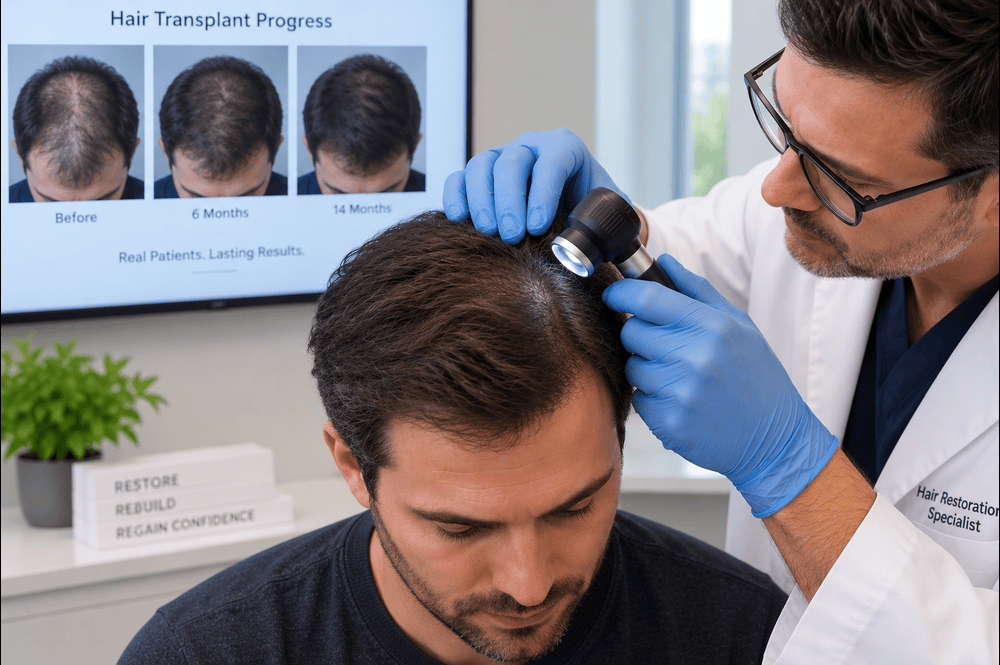
If you are in the second category, the useful step is a scalp evaluation with trichoscopy and standardized photography rather than another round of forum opinions. Miniaturization is visible under magnification long before it is visible in a mirror, and it tells you whether you are looking at a cycling artifact or ongoing androgenetic progression.
What you can reasonably do about it
If the dip is cycling, the honest answer is that you wait, because nothing needs fixing. What is worth doing in the meantime is making sure the modifiable variables are handled: medication compliance for the native hair, and consistent photographic tracking so that six months from now you have real evidence rather than an impression.
For patients who cannot tolerate systemic DHT blockers, adjunctive options such as platelet-rich plasma or growth factor and exosome therapy are sometimes used to support the surrounding native hair, though a recent review of regenerative therapies for pattern hair loss is appropriately measured about the strength of that evidence PRP has the most randomized support, exosome therapy considerably less. Neither is a substitute for a DHT blocker in someone who can take one.
If, after a full year of tracking, density genuinely has not recovered and miniaturization is not the explanation, then the conversation is about under-density in the original plan and whether a second, smaller session is warranted a normal outcome for high-Norwood cases, not a scandal.
The bottom line
A density dip somewhere after the first year is a real and biologically expected event, because a transplant creates an artificially synchronized population of follicles that has to spread back out. It is not evidence that your grafts died. But it is also not a universal explanation, and the far more common cause of a thinning transplanted zone is untreated native hair loss carrying on around perfectly healthy grafts.
Distinguish between them with magnification and standardized photos, not with reassurance.
A note from us
If you are a year or more past a hair transplant and the density is going the wrong way, a scalp evaluation will usually answer the question quickly. The Hair Restoration Institute of Minnesota offers a free consultation, including for patients whose original procedure was performed elsewhere. More at hrimn.com.
